Peterborough (Parliamentary Constituency)

Peterborough town centre.

Peterborough is a wealthy post-industrial city in North Cambridgeshire. Unlike a lot of post-industrial areas, Peterborough has done very well for itself. This is principally because it was built up as a ‘newtown’ in the 60s and 70s and had a high quality service industry and good transport links that allowed it to become a place for commuters to London and Cambridge. Peterborough is a swing seat between Labour and the Conservatives.
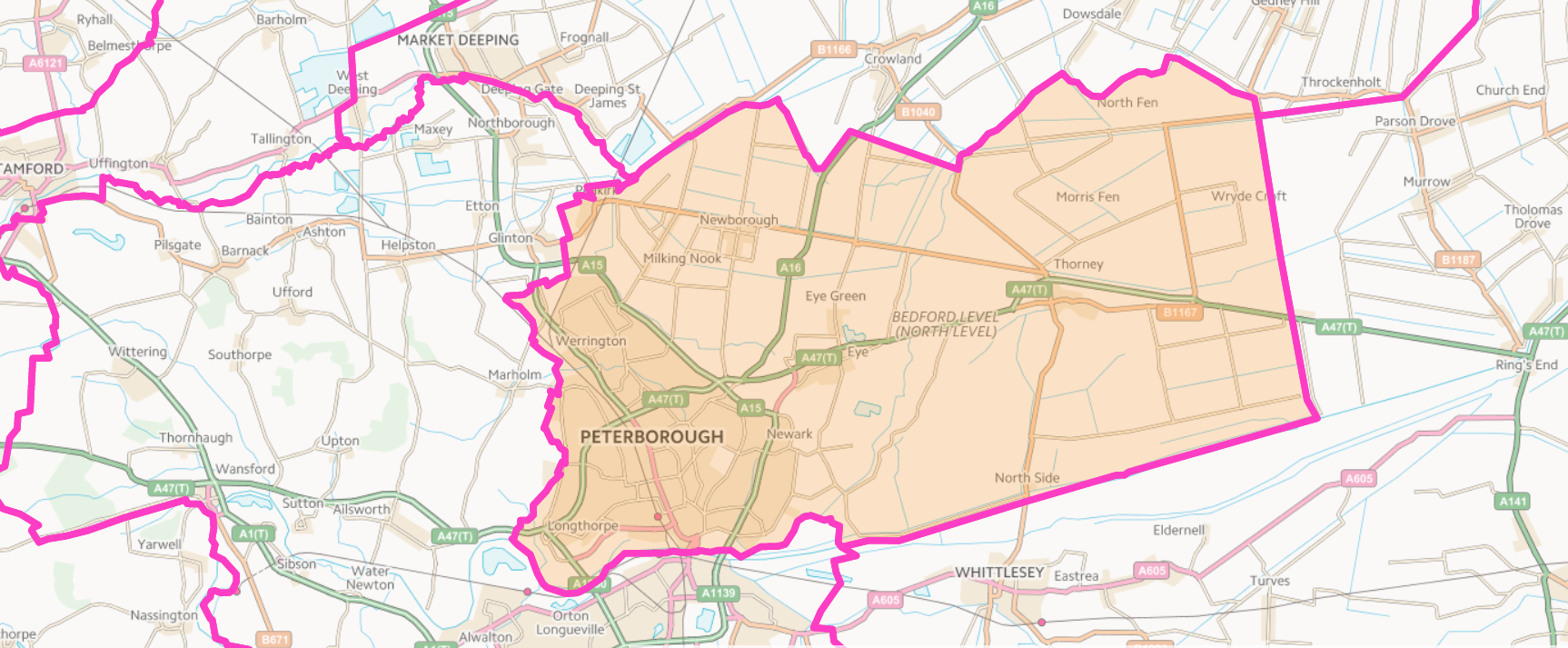
Map of Peterborough.
Contains Ordnance Survey data © Crown copyright and database right 2015 Contains Royal Mail data © Royal Mail copyright and database right 2015 Contains National Statistics data © Crown copyright and database right 2015

About the Area

The constituency takes up the city of Peterborough itself and the flatlands to the east, where sit the villages of Thorney and Eye. There has been settlement on the river Nene that flows past the city since the bronze ages. Any piece of dry land is a rare commodity in the Fenlands. The area was settled by Romans, Anglo-Saxons and Vikings. The Cathedral was originally built in the 12th Century and has grown in size and importance ever since. The town really had a boom though in the mid 19th century where it became a major hub for brick making. A hundred years later it grew as a ‘newtown’ with many waves of migrants coming to settle in the city. The economy of the area now relies on the service and distribution industries and being a commuter town on the M11 Corridor.

River Nene running through Peterborough.

Politics

The 2017 General Election Result.

Peterborough is seen as a key marginal to whoever holds the keys of number 10. Labour took the seat in their landslide victory in 1997 but then lost it to the Tories in 2005, who held it for a decade until it was retaken by then Labour candidate: Fiona Onasanya. According to Dr Chris Hanretty’s estimates, the seat voted to leave the European Union by a margin of 61.3% to 38.7%. This is reflected in it’s 2015 result where UKIP won 15.9% of the vote share, slightly above the national average. Due to being convicted of a crime, Onasanya has been thrown from the Labour party and eventually stepped down, causing a by-election.

Member of Parliament

Fiona Onasanya.

In 2017, Fiona Onasanya was elected as a Labour MP. Later that year, she was convicted of lying about a speeding offence. This lead to a multi-year embarrassment, that eventually lead to her being thrown from the Labour Party and her standing down and causing a by-election. In her very brief time as a Labour MP and as an Independent MP she generally voted along Labour party lines and for pro-EU votes and policies. The by-election for the constituency will take place on the 6th June 2019 with Labour, the Conservatives and Brexit Party hoping to take the seat.

Chippenham (Parliamentary Constituency)

The main bridge over the Avon in Bradford-on-Avon.

Named after the large market town at its northern end, the Chippenham constituency sprawls lazily across the central valley of the Bristol Avon. From the cookie-cutter suburbs of Chippenham itself, to the smokey rubber works of Melksham, to the Picturesque Bradford. Unlike, the Tory bulwarks of the rest of Wiltshire, The Conservative party here faces some kickback from the left leaning and liberal populations of the towns. But more on that in a bit.

Map of the Chippenham Constituency.
Contains Ordnance Survey data © Crown copyright and database right 2015 Contains Royal Mail data © Royal Mail copyright and database right 2015 Contains National Statistics data © Crown copyright and database right 2015

About the Area

By far the four largest settlements in this seat are the towns of: Chippenham (45,337), Melksham (14,677), Corsham (13,000) and Bradford-on-Avon (9402). The constituency contains these four towns and the wealthy countryside between them. The area is a patchwork of farmland, forested hills, small picture postcard villages, such as Lacock, and suburban sprawl. Chippenham itself has a history that stretches all the way back to Alfred the Great and even before. It grew from humble beginnings into a bustling market town on the Avon, until it and the other three in the constituency were revolutionised by the railway. Nowadays, Chippenham’s main economic purpose is as a commuter town to Bristol, Swindon and London. Not to say there aren’t important local industries. The MOD has many sites throughout the Corsham area that employs a huge amount of local workers. On top of this there are rail engineering factories in Chippenham and the rubber works in Melksham, as well as a variety of business parks.

St Andrews Church in Chippenham.

Politics

The seat was created in time for the 2010 General Election out of parts of Devizes, North Wiltshire and Westbury. It was immediately won by Liberal Democrat: Duncan Hames who went on to become Nick Clegg’s parliamentary primary secretary and marry the now deputy leader of the party; Jo Swinson.

In 2015, during the Liberal Democrat collapse, the seat fell into the hands of the Tories in the form of freshman MP: Michelle Donelan, who has served the constituency ever since. According to Dr Chris Hanretty’s estimates, in the 2016 EU Referendum, Chippenham voted to leave by very narrow margins, likely similar to the UK vote overall.

The 2017 General Election Result.

Michelle Donelan won the seat again with an increased vote share, winning a majority in the 2017 election. The election also saw the Lib Dems lose vote share to the Tories and Labour, who made a swing of over 11%. This was maybe due to the party’s stance on Brexit. The strong local representation and history in the area, likely still makes the Lib Dems the best option for anyone wishing to tactically vote against the Tories though.

Member of Parliament

Michelle Donelan (left) alongside Andrea Leadsom (right).

Michelle Donelan can be easily placed into the parliamentary group of Conservative Front Bench Loyalists. She supported remaining in the European Union before the referendum but has since then has voted with Prime Minister: Theresa May’s position on her deal for exiting, on all related votes. Aside from this, Michelle could be described as a classic middle-of-the-road Conservative, voting for: pro-military, reduced welfare, pro-corporate and anti-reform policies. She was a member of Education Select Committee and is now a Conservative assistant whip.